Children's Learning
How activity books support creative learning
2 August 2026 · 6 min read
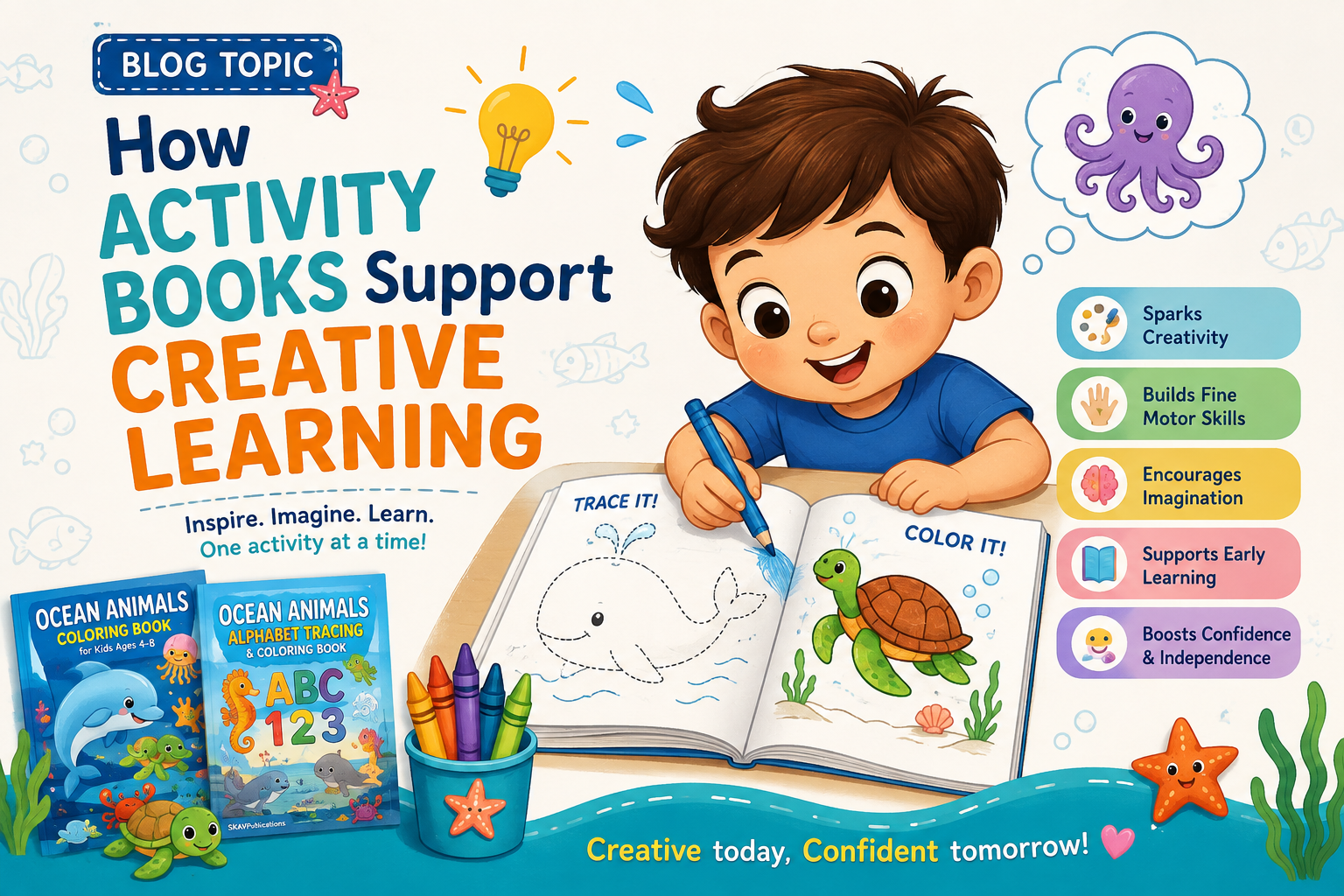
A good activity book does something quietly remarkable: it turns a blank ten minutes into a small, finished piece of work. For a five-year-old, that finished feeling is not a bonus — it is the whole lesson.
Short tasks build long confidence
Young children work in bursts. Attention arrives in waves of five to twelve minutes, and the best books are built to match that rhythm rather than fight it. A maze, a tracing row, a spot-the-difference — each is a complete unit with a beginning, a middle and a visible end.
That completeness matters more than difficulty. When a child finishes something without being rescued, they collect evidence that they are capable. Fifty small pieces of evidence, gathered over a term, do far more for confidence than one impressive but adult-assisted project.
Structure is what makes creativity possible
It sounds backwards, but constraint is generous. A page that says 'finish this drawing' gives a child somewhere to start, and starting is the hardest part of creative work at any age.
In our Trace, Complete & Create book we sequence this deliberately: trace a light-lined shape, then complete a half-drawn scene, then invent the missing elements. By the third stage the child is drawing freely — but they arrived there on a ramp, not a cliff.
What to look for on the page
Generous white space, so a small hand has room to move and a busy mind has room to rest. One instruction per page, written in language the child can read or recognise. Line weight heavy enough for crayons. Single-sided printing so markers do not ruin the next activity.
And progression: the last chapter should ask more than the first. A book that stays flat for ninety pages is a worksheet pack, not a learning experience.
How to use one well at home
Keep sessions short and stop while the child still wants more. Resist correcting — an imperfect line the child owns is worth more than a neat line you guided. Let them choose the page; agency is half the motivation.
Most of all, treat it as quiet time rather than schoolwork. The learning is real, but it works best when nobody announces it.
In short
Choose books with short, complete tasks, clear instructions and gentle progression — then get out of the way.